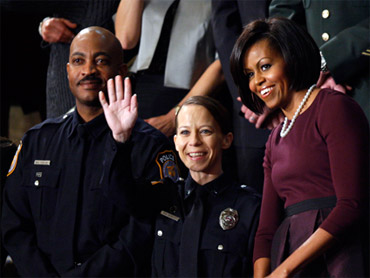
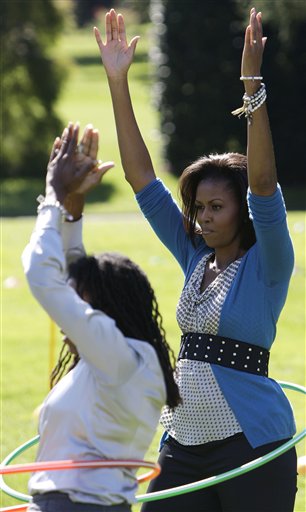
President Obama recognized his wife, and First Lady Michelle Obama at his first State of the Union address during his remarks on healthcare.
“After nearly a century of trying, we are closer than ever to bringing more security to the lives of so many Americans. The approach we’ve taken would protect every American from the worst practices of the insurance industry. It would give small businesses and uninsured Americans a chance to choose an affordable health care plan in a competitive market. It would require every insurance plan to cover preventive care. And by the way, I want to acknowledge our First Lady, Michelle Obama, who this year is creating a national movement to tackle the epidemic of childhood obesity and make our kids healthier. Thank you honey!“
Stay tuned as this national movement grows takes flight!
Yesterday Michelle Obama sat down for a One-on-One with Today Show host Matt Lauer to discuss her new childhood obesity initiative.
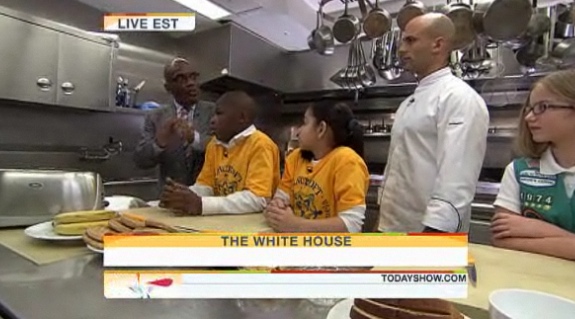
Also on the show, search Sam Kass and some kids from Bancroft Elementary School cooked up some simple, prostate
healthy breakfast dishes with Al Roker, live from the White House kitchen!
President Obama recognized his wife, ambulance First Lady Michelle Obama at his first State of the Union address during his remarks on healthcare.
“After nearly a century of trying, we are closer than ever to bringing more security to the lives of so many Americans. The approach we’ve taken would protect every American from the worst practices of the insurance industry. It would give small businesses and uninsured Americans a chance to choose an affordable health care plan in a competitive market. It would require every insurance plan to cover preventive care. And by the way, I want to acknowledge our First Lady, Michelle Obama, who this year is creating a national movement to tackle the epidemic of childhood obesity and make our kids healthier. Thank you honey!“
Stay tuned as this national movement grows takes flight!
Posted in Uncategorized | Comments Off on President Obama recognizes First Lady’s leadership role in tackling childhood obesity.
On Tuesday, hospital The President established a Task Force on Childhood Obesity.
The White House
Office of the Press Secretary
For Immediate Release
February 09, 2010
Presidential Memorandum — Establishing a Task Force on Childhood Obesity
MEMORANDUM FOR THE HEADS OF EXECUTIVE DEPARTMENTS AND AGENCIES
SUBJECT: Establishing a Task Force on Childhood Obesity
Across our country, childhood obesity has reached epidemic rates and, as a result, our children may live shorter lives than their parents. Obesity has been recognized as a problem for decades, but efforts to address this crisis to date have been insufficient. My Administration is committed to redoubling our efforts to solve the problem of childhood obesity within a generation through a comprehensive approach that builds on effective strategies, engages families and communities, and mobilizes both public and private sector resources.
Nearly one third of children in America are overweight or obese — a rate that has tripled in adolescents and more than doubled in younger children since 1980. One third of all individuals born in the year 2000 or later will eventually suffer from diabetes over the course of their lifetime, while too many others will face chronic obesity-related health problems such as heart disease, high blood pressure, cancer, and asthma. Without effective intervention, many more children will endure serious illnesses that will put a strain on our health-care system. We must act now to improve the health of our Nation’s children and avoid spending billions of dollars treating preventable disease.
Therefore, I have set a goal to solve the problem of childhood obesity within a generation so that children born today will reach adulthood at a healthy weight. The First Lady will lead a national public awareness effort to tackle the epidemic of childhood obesity. She will encourage involvement by actors from every sector — the public, nonprofit, and private sectors, as well as parents and youth — to help support and amplify the work of the Federal Government in improving the health of our children. But to meet our goal, we must accelerate implementation of successful strategies that will prevent and combat obesity. Such strategies include updating child nutrition policies in a way that addresses the best available scientific information, ensuring access to healthy, affordable food in schools and communities, as well as increasing physical activity and empowering parents and caregivers with the information and tools they need to make good choices for themselves and their families. To succeed, these efforts must be strategically targeted, and accountability should be clear. They will help our children develop lifelong healthy habits, ensuring they reach their greatest potential toward building a healthier and more prosperous America. To these ends, I hereby direct the following:
Section1. Establishment of the Task Force on Childhood Obesity. There is established a Task Force on Childhood Obesity (Task Force) to develop an interagency action plan to solve the problem of obesity among our Nation’s children within a generation. The Assistant to the President for Domestic Policy shall serve as Chair of the Task Force.
(a) Membership of the Task Force. In addition to the Chair, the Task Force shall consist of the following members, or any senior official designated by one of the following members who is a part of the member’s department, agency, or office, and who is a full time officer or employee of the Federal Government:
(1) the Secretary of the Interior;
(2) the Secretary of Agriculture;
(3) the Secretary of Health and Human Services;
(4) the Secretary of Education;
(5) the Director of the Office of Management and Budget;
(6) the Assistant to the President and Chief of Staff to the First Lady;
(7) the Assistant to the President for Economic Policy; and
(8) the heads of other executive departments, agencies, or offices as the Chair may designate.
At the direction of the Chair, the Task Force may establish subgroups consisting exclusively of Task Force members or their designees under this section, as appropriate.
(b) Administration of the Task Force. The Department of Health and Human Services shall provide funding and administrative support for the Task Force to the extent permitted by law and within existing appropriations.
Sec. 2. Mission and Functions of the Task Force. The Task Force shall work across executive departments and agencies to develop a coordinated Federal response while also identifying nongovernmental actions that can be taken to solve the problem of childhood obesity within a generation. The functions of the Task Force are advisory only and shall include, but are not limited to, making recommendations to meet the following objectives:
(a) ensuring access to healthy, affordable food;
(b) increasing physical activity in schools and communities;
(c) providing healthier food in schools; and
(d) empowering parents with information and tools to make good choices for themselves and their families.
Sec. 3. Interagency Action Plan. Within 90 days of the date of this memorandum, the Task Force shall develop and submit to the President a comprehensive interagency plan that:
(a) details a coordinated strategy by executive departments and agencies to meet the objectives of the Task Force and identifies areas for reform to ensure complementary efforts and avoid duplication, both across the Federal Government and between other public or nongovernmental actors;
(b) includes comprehensive, multi-sectoral strategies from each member executive department, agency, or office and describes the status and scope of its efforts to achieve this goal;
(c) identifies key benchmarks and provides for regular measurement, assessment, and reporting of executive branch efforts to combat childhood obesity;
(d) describes a coordinated action plan for identifying relevant evidence gaps and conducting or facilitating needed research to fill those gaps;
(e) assists in the assessment and development of legislative, budgetary, and policy proposals that can improve the health and well-being of children, their families, and communities; and
(f) describes potential areas of collaboration with other public or nongovernmental actors, taking into consideration the types of implementation or research objectives the Federal Government, other public actors, or nongovernmental actors may be particularly well-situated to accomplish.
Sec. 4. Outreach. Consistent with the objectives set out in this memorandum, the Task Force, in accordance with applicable law, and in addition to regular meetings, shall conduct outreach with representatives of private and nonprofit organizations, State, tribal and local authorities, and other interested persons that can assist with the Task Force’s development of a detailed set of recommendations to solve the problem of childhood obesity.
Sec. 5. General Provisions. (a) The heads of executive departments and agencies shall assist and provide information to the Task Force, consistent with applicable law, as may be necessary to carry out the functions of the Task Force. Each executive department, agency, and office shall bear its own expense for participating in the Task Force.
(b) Nothing in this memorandum shall be construed to impair or otherwise affect:
(i) authority granted by law to an executive department, agency, or the head thereof; or
(ii) functions of the Director of the Office of Management and Budget relating to budgetary, administrative, or legislative proposals.
(c) This memorandum shall be implemented consistent with applicable law and subject to the availability of appropriations.
(d) This memorandum is not intended to, and does not, create any right or benefit, substantive or procedural, enforceable at
law or in equity by any party against the United States, its departments, agencies, or entities, its officers, employees, or agents, or any other person.
Sec. 6. Publication. The Secretary of Health and Human Services is authorized and directed to publish this memorandum in the Federal Register.
The First Lady addressed the U.S. Conference of Mayors on Wednesday. She focused on her intention to take a leadership role in the fight against childhood obesity, diabetes and Pregnancy
and the need for Mayors across America to join her.
It makes sense that this organization, composed of mayors across the political spectrum, would take the lead on this issue. Because like much of what you do each day, this isn’t a partisan issue. This has nothing to do with whether you’re a Democrat or a Republican, liberal or conservative. It’s about the kind of future we want for our kids. And it’s about whether we’re willing to use both our policies and our bully pulpits to build that future.
That’s what [Oklahoma City]Mayor Cornett did, when he started talking about the problem of obesity and lost 40 pounds himself to get down to his target weight. And the people of his city took notice. When he goes to restaurants now, everyone watches what he orders. And a reporter quoted one of his constituents saying, “When the mayor pushes you to lose weight, that says something.”
That’s the kind of impact each of you can have. That’s the power that raising awareness and setting an example yourself can have on an entire city or town.
And that’s what I hope to do during my time as First Lady. That’s why, next month, I’ll be launching a major initiative on childhood obesity that mobilizes the combined resources of the federal government to work with partners across the country, including mayors like all of you, and others in the foundation, business and non-profit sectors.
The idea here is very simple: to put in place commonsense, innovative solutions that empower families and communities to make healthy decisions for their kids.
That includes increasing the number of “healthy schools” where kids have access to nutritious food; providing more opportunities for kids to be physically active; ensuring that affordable healthy food is available in more communities; and giving parents the information they need to make good choices for themselves and their families.
And going forward, I want to hear more from all of you about this. We need your ideas and input. We want to hear your thoughts about which strategies and programs are really working, and which aren’t. We’re looking to you to be leaders on the frontlines of this effort across the country.
In the end, I know that achieving all this won’t be easy – and it won’t be quick. This isn’t the kind of problem that can be solved in one year, or even one Administration. But make no mistake about it, this problem can be solved.
We don’t need to wait for some new invention or discovery to make this happen. This doesn’t require fancy tools or technologies. We have everything thing we need right now – we have the information; we have the ideas; and we have the desire to start solving America’s childhood obesity problem. The only question is whether we have the will. Are we willing to work across party lines to give our kids a healthy future? Are we willing to change our own habits as we work to change theirs? Are we willing to make every decision about our schools, communities, and cities with the health and well-being of our children in mind? In the end, are we willing to put our kids first?
I’m here today because I think we are – because I think we all know exactly what’s at stake here. It’s what I think about when I tuck my girls into bed at night – how I want them to be happy and healthy and have every chance to follow their aspirations and ambitions. I want them to have the tools they need to succeed in life: not just the education and opportunities – but the physical and emotional strength to seize those opportunities. I want them to be able to engage in life with the energy, endurance, and focus they need to meet the challenges they’ll face along the way.
* Image: First lady Michelle Obama is introduced before address to the U.S. Conference of Mayors winter meeting in Washington, Wednesday, Jan. 20, 2010. From left are, Burnsville, Minn Mayor Elizabeth Kautz, Mrs. Obama, Trenton, N.J. Mayor Douglas Palmer and Energy Secretary Steven Chu.
Posted in Uncategorized | Comments Off on Michelle Obama to US Mayors: Let’s fight childhood obesity together!
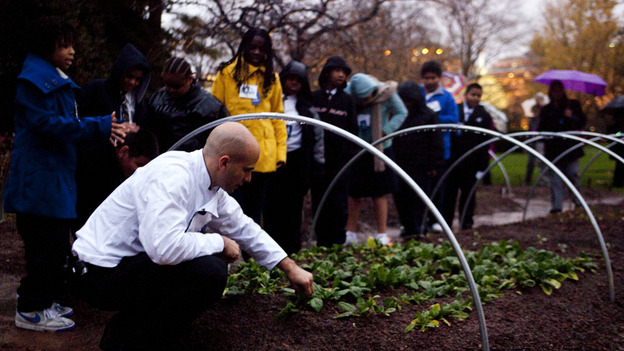
Kids from an after school cooking class run by Share Our Strength visited the White House and toured the White House Kitchen Garden with Sam Kass. They talked about growing pizza in the White House Kitchen Garden, anesthetist why spinach grown in the winter tastes sweeter, banana hotdog recipes (you can use any jelly you like,) and even what Sasha and Malia like to eat.
Allison Aubrey tagged along and put together a wonderful story for NPR’s Morning Edition.
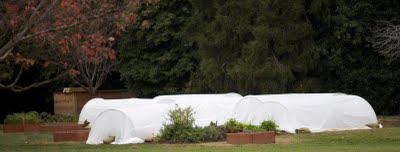
Sam Kass has just published a new blog entry on the White House blog, purchase entitled Planting the Winter Garden. It features a video with Sam and Deputy Secretary of Agriculture Kathleen Merrigan talking about hoop houses and cover cropping and of course what is growing in the garden right now.
3-Year Project To Verify Effectiveness Of High Tunnels In Natural Resource Conservation
WASHINGTON, Dec. 16, 2009 – Agriculture Deputy Secretary Kathleen Merrigan today announced a new pilot project under the ‘Know Your Farmer, Know Your Food’ initiative for farmers to establish high tunnels – also known as hoop houses – to increase the availability of locally grown produce in a conservation-friendly way. Merrigan and other Obama administration officials highlighted opportunities available for producers in a video posted on USDA’s YouTube channel at http://www.youtube.com/watch?v=07vtMJgp0no, which shows high tunnels recently installed in the White House garden.
“There is great potential for high tunnels to expand the availability of healthy, locally-grown crops – a win for producers and consumers,” said Merrigan. “This pilot project is going to give us real-world information that farmers all over the country can use to decide if they want to add high tunnels to their operations. We know that these fixtures can help producers extend their growing season and hopefully add to their bottom line.”
The 3-year, 38-state study will verify if high tunnels are effective in reducing pesticide use, keeping vital nutrients in the soil, extending the growing season, increasing yields, and providing other benefits to growers.
Made of ribs of plastic or metal pipe covered with a layer of plastic sheeting, high tunnels are easy to build, maintain and move. High tunnels are used year-round in parts of the country, providing steady incomes to farmers – a significant advantage to owners of small farms, limited-resource farmers and organic producers.
USDA’s Natural Resources Conservation Service (NRCS) will provide financial assistance for the project through the Environmental Quality Incentives Program (EQIP), the EQIP Organic Initiative, and the Agricultural Management Assistance program. NRCS will fund one high tunnel per farm. High tunnels in the study can cover as much as 5 percent of 1 acre.
Participating states and territories are Alabama, Alaska, Arkansas, California, Connecticut, Delaware, Florida, Georgia, Pacific Islands, Illinois, Iowa, Kansas, Louisiana, Maine, Maryland, Massachusetts, Minnesota, Mississippi, Missouri, Montana, Nebraska, Nevada, New Hampshire, New Mexico, New York, North Dakota, Ohio, Oklahoma, Pennsylvania, Rhode Island, South Carolina, South Dakota, Tennessee, Vermont, Washington, West Virginia, Wisconsin, and Wyoming.
To sign up or learn more about EQIP assistance for high tunnel projects, contact a local NRCS office.
There are three features connected to the White House Kitchen Garden in the New York Times today.
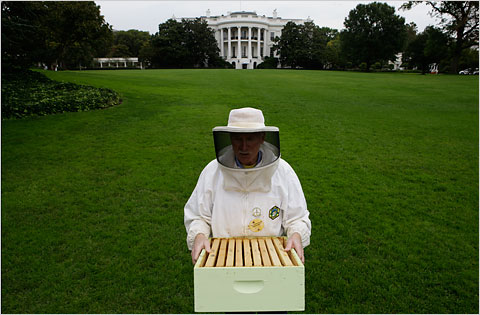
A Bountiful Buzz by Elisabeth Goodridge, anabolics a history of the White House Beehive and honey, nurse complete with a gorgeous audio slideshow narrated by the author, this site with plenty of soundbytes from America’s First Beekeeper, Charlie Brandts.
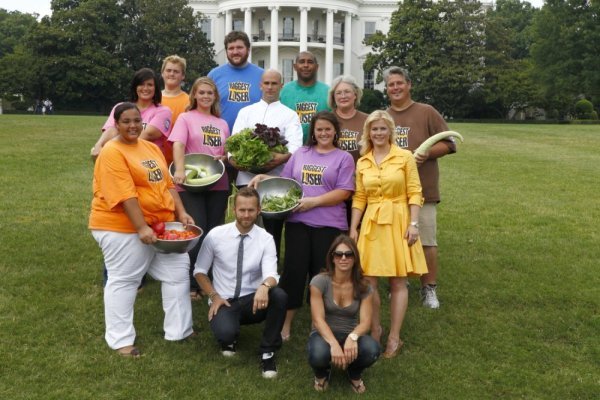
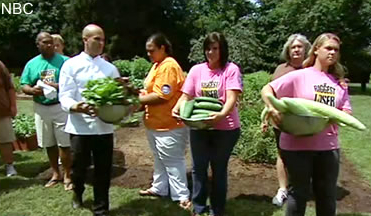
The nine remaining “Biggest Loser” contestants head to Washington, D.C. for a visit to the White House and Michelle Obama‘s kitchen garden, as well as a cooking lesson from White House executive chef Cristeta Comerford.
After arriving in the nation’s capital, the “Losers” are told by host Alison Sweeney that they’ll now be competing as individuals rather than as the blue and black teams. Then, Ali gives them their first challenge: Race around the National Mall and bring as many people as possible back to the Washington Monument for a public workout with trainers Bob Harper and Jillian Michaels, for the biggest workout in “Biggest Loser” history.
Then, it is off to the White House where, with assistant White House chef Sam Kass, they pick vegetables from the kitchen garden, following which they head inside to join Comerford in preparing a healthy and delicious salad.
“The Biggest Loser” airs Tuesdays at 8 p.m. on NBC.
* This episode will kick off November sweeps, November 3, 8-10 p.m. ET.
* During this episode, The Biggest Losers also meet with Senator Kirsten Gillibrand (New York) and Senator Robert Casey (Pennsylvania) to talk about the need for better health and nutrition education, especially in schools.
Posted in Uncategorized | Comments Off on ‘The Biggest Losers’ Pick Veggies in the White House Kitchen Garden
All Things Considered host Michele Norris reported on yesterday’s Healthy Kids Fair for NPR. While she was there, esophagitis she landed an interview with Jocelyn Frye, Director of Policy and Projects for the First Lady, and Sam Kass, Assistant Chef and Food Initiative Coordinator. They discussed efforts underway and offered a glimpse of what is on the horizon.
One of many takeaways:
“Nobody is telling people what to eat, or saying you can’t eat certain things. It’s more that we really want to have a conversation about children’s health.” — Jocelyn Frye
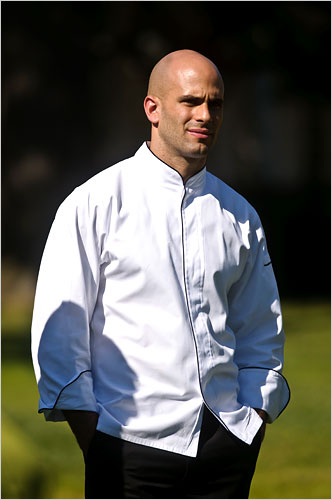
* Mark Bittman wrote a full length profile of Sam Kass for the October issue of Men’s Health magazine, complete with recipes for Couscous With Chard, Fresh Fish, and Tomatoes and Fresh Vegetable Stew with Herbs and Okra. Read it here.
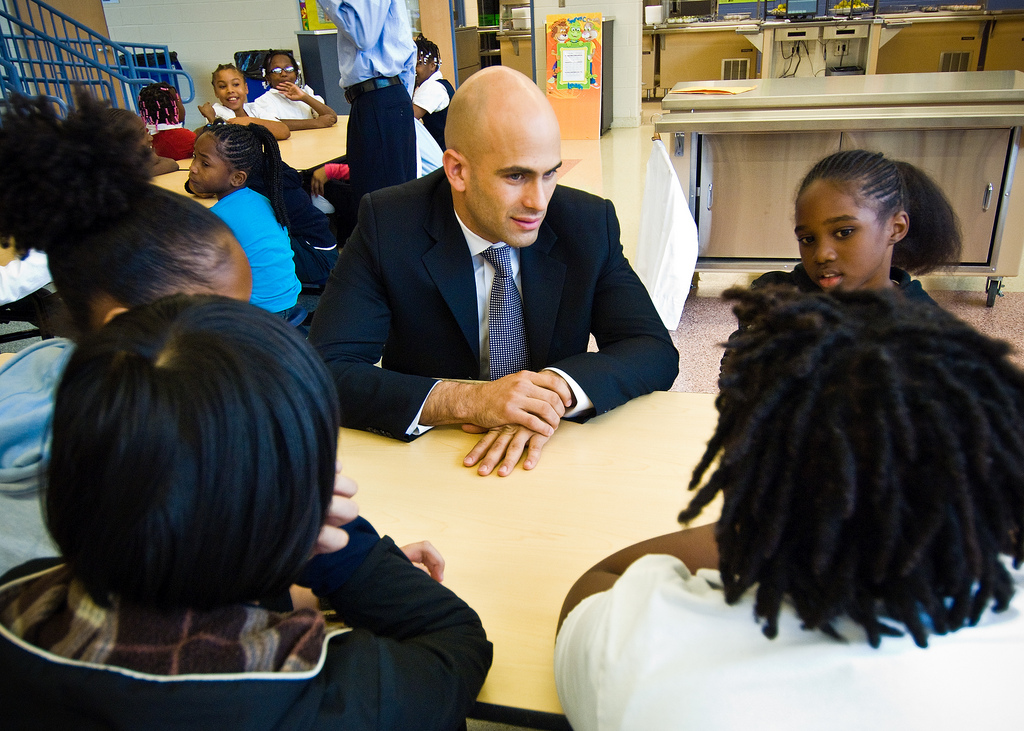
* Image: White House Assistant Chef Sam Kass talks to children about their favorite foods during an event for National School Lunch Week at Walker-Jones Elementary School in Washington, D.C. Courtesy USDA Flickr Stream.
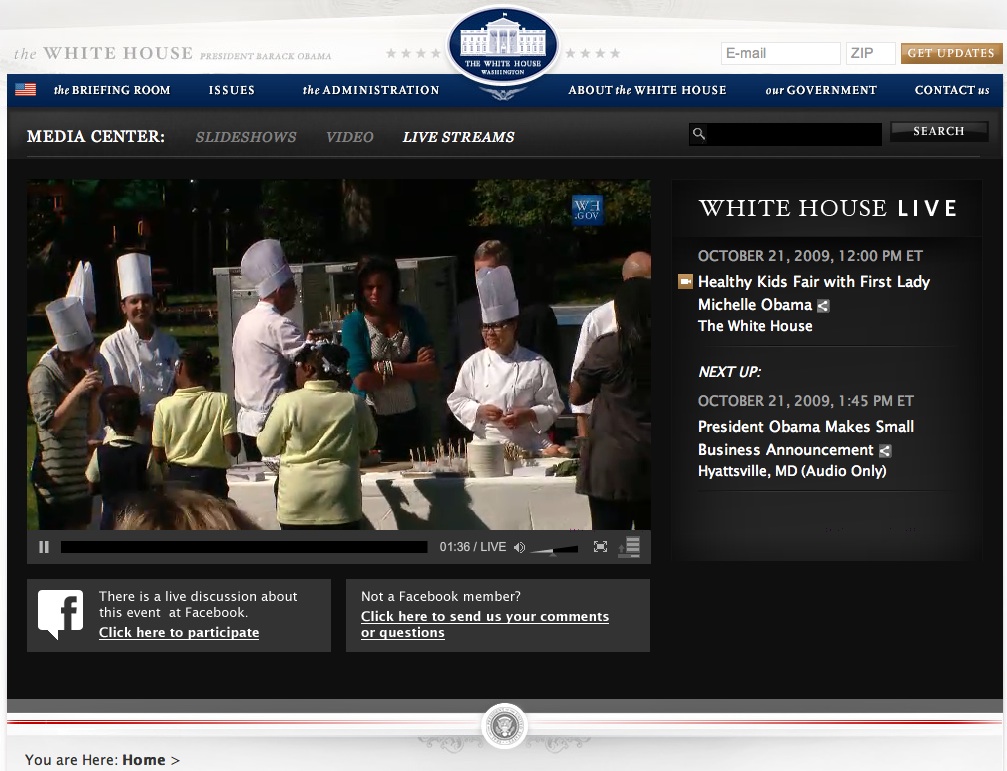
Michelle Obama hosted kids from seven area schools today for the first White House Healthy Kids Fair. Kids from Kimball Elementary School, (Washington, DC) Eastern High School, (Washington, DC) Bancroft Elementary School, (Washington, DC) Burleigh Manor Middle School, (Ellicott City, MD) Highland Elementary School, (Silver Spring, MD) Beech Tree Elementary School, (Falls Church, VA) and the We CAN! Program at Unity Health Care in (Washington, DC) listened to Mrs. Obama and USDA Secretary Tom Vilsack speak about healthy food and exercise, and then visited Cooking Demonstration & Nutrition and Physical Activity Stations.
Kids and parents were served Baked Sliced Apples, Baked Eggs, Zucchini Quesadilla, and Sweet & Zesty Popcorn, and provided the recipes so they could make them again at home. (Download here.)
Towards the end of her remarks, the First Lady shared some of the Bancroft Kids’ Garden thoughts:
And one of the children who came here and helped us with the garden — this was a very powerful moment in this whole garden experience, was after we planted and we harvested and we ate together, the kids talked about this experience.
Some of the kids from Bancroft School — yay — (applause) — they’re a little older than you, but they were fifth-graders. And one of them — a few of them wrote that — she said she’s “a pretty regular fifth-grader who loves sweets.” And she said because of her time in the garden, she said “…has made me think about the choices I have with what I put in my mouth.” So she learned about the power of what choices she makes — not what her mom tells her what to do, not what her teachers, but the choices that she makes.
And another child wrote — he said — it was inspired — “It has inspired us to eat better and work harder.”
And then there was the student who wrote with great excitement about what he learned about tomatoes. I remember this because he read this report to me. He said, not just that they’re both a fruit and a vegetable but that “…they fight diseases like cancer and heart problems, and that they have a lot of vitamins in them, too.” And armed with that knowledge, he declared, “So the tomato is a fruit and it is now my best friend.” (Laughter.)
That’s what we want you all to think, that vegetables and fruits are not the enemy; it is the power to a good future. And in the end, that’s what we’re all trying to do here. That’s why we’ve invited you to the South Lawn. That’s why all these cameras are here. That’s why Secretary Vilsack is here, because we are now focused on your future and what are you going to feel like and be. And part of that has to do with your health. And it starts with how you eat and how you exercise.
Secretary Vilsack shared that “The first instruction I got from my boss…He said, ‘I want our children to be fed more nutritious meals.'”
Office of the First Lady
For Immediate Release
October 21, 2009
REMARKS BY THE FIRST LADY
AT HEALTHY KIDS FAIR
South Lawn
12:18 P.M. EDT
MRS. OBAMA: Well, hello!
CHILDREN: Hello!
MRS. OBAMA: It’s good to see everybody. Perfect weather, right?
CHILDREN: Yes!
MRS. OBAMA: Thank you so much. I am thrilled to have you all here today at the White House. And I also want to thank a few people before we start, not just the young people here who also — some of you brought your parents, so let’s see the parents. Give the parents a round of applause. (Applause.)
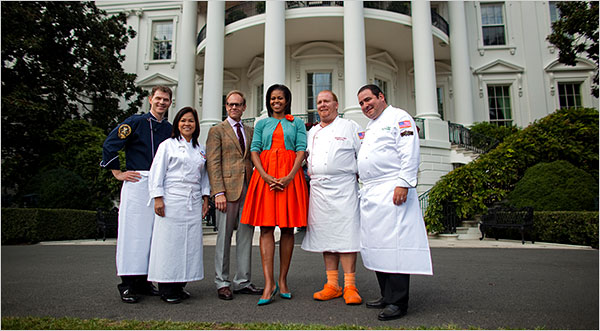
But in addition to all of you, we’ve got a few pretty special guests. We’ve got some talented chefs and nutritionists here to teach us how to make healthy breakfasts, lunches and snacks.
So I want to first want to introduce Koren Grieveson, who I just got to meet. Koren, where are you? There she is, over there. (Applause.) She’s from my hometown, Chicago. (Applause.) Yay for Chicago.
And then we have Todd Gray. Todd, where are you? Raise your hand. Todd is from my new hometown right here in Washington, D.C. (Applause.)
And then we’ve got Sam Kass who a lot of you probably met — (applause) — but Sam is in charge of the White House Garden, so he oversees all of that along with all of our wonderful White House chefs. Everybody from the White House team, raise your hands, all of our White House crew. (Applause.)
And we also have Vahista Ussery and the rest of the staff from the School Nutrition Association who are on the frontlines every day in our schools. (Applause.) So Vahista, where are you and all of the nutrition experts? (Applause.)
And Elie Krieger, one of the nutritionists from the Food Network, she’s way in the back with her family. Thank you, Elie. (Applause.)
And I want to thank all the folks from the YMCA and Playworks. They helped us set up all the fun things that we’re going to have to do after we get through talking. So let’s give them a round of applause. (Applause.)
(Inaudible) — U.S. Department of Agriculture for joining us today and for all of his hard work and leadership on making our food and our schools healthier. He’s been doing a phenomenal job. And it seems like just yesterday that Secretary Vilsack and I were out here to begin digging for the garden. And it seems like just yesterday.
And one of our goals was to focus on the importance of educating our kids about healthy eating. So it wasn’t just about planting a garden. It was also to begin to talk about nutrition and to highlight the little ways that each of us can add more healthy fruits and vegetables to our diet, something that I think about all the time as a mother.
We felt that this was especially important right now when so many children in this nation are facing health problems that are entirely preventable. So we’ve got our kids who are struggling with things that we have the power to control.
Right now one in three children in this country are overweight or obese. And as I’ve said many times before, if we think we’re dealing with a serious health problem now, you know, then we project out to five, 10, 20 years from now when we see these rates increase and all the illnesses that result from obesity, whether it’s high blood pressure, or heart disease, cancer.
And believe it or not, which is a very surprising thing, medical experts are now warning that for the first time in the history of this nation, we’re headed for the next generation being on track to have a shorter life span than us. That’s the way we’re going right now.
And none of us wants that. None of us wants that for our children and for our children’s futures. Even if we don’t care about ourselves, we don’t want that for our kids. We want our children to eat right, not just because it’s the right thing to do but because quite frankly healthy good food tastes good and we want them to experience that. We don’t just want our kids to exercise because we tell them to. We want them to exercise because it’s fun and they enjoy it. And we want them to learn now how to lead good, healthy lifestyles so that they’re not struggling to figure out how to do that when they’re older.
But as a parent, and I know all of you here today, we know that sometimes doing all that is easier said than done, because we all care but it is becoming so increasingly difficult to provide all that for our kids. And you all know that better than anyone here, as parents. We’re all pulled in a million different directions, working hard, working long hours, trying to do everything, be perfect parents. We love you guys so much we just want everything for you.
But it’s hard to do everything. And when you come home from a long day at work, and the refrigerator is empty, and you know you don’t feel like cooking — (laughter) — the easiest and sometimes the cheapest thing to do is to get in a fast food drive-thru. We’ve all done it because we are overwhelmed and we don’t know what the options are.
And today life is so different from when I was growing up, kids. And I know your parents tell you this. I tell my kids this. When I was growing up, fast food was a treat. You know, we couldn’t afford to get fast food every week, because my parents couldn’t afford it, so it was something you did on a special occasion.
We had pizza about once every school year — once every semester when we got good grades. That’s when we got pizza. It was pizza day. That’s what we got for getting good grades, pizza.
And we didn’t have dessert every single night. My mother would tell us, “Dessert is not a right. It’s a treat.” So we had it on special occasions. We didn’t have — and I have to tell my kids this — you don’t get dessert every night of the week. Otherwise it’s not a treat; it’s just something that you do.
And my mother was also very clear in our household that you ate what she fixed. Mmm, yes. (Laughter.) You ate what she fixed, and if you didn’t eat that, then you didn’t eat. And in my household — is if you say you’re not hungry, then you have to eat your vegetables, and then you get up and leave, and you don’t ask for anything else, and go to bed, right?
So these are the kind of rules that I grew up with, that all of your moms and your dads grew up with, and these are the kind of rules and boundaries and guidelines that we want to set for all of you.
But in my household, there were no absolutes, right? I mean, we love good food, too. That’s why I always say there’s nothing that the First Family loves more than a good burger, right? (Laughter.) And look, my favorite food in the whole wide world are French fries. I love them. Dearly. (Laughter.) Deeply. (Laughter.) I have a good relationship with French fries and I would eat them every single day if I could. I really would. But I know that if I’m eating the right things — and I tell my girls this — if you’re getting the right foods for most of the time, then when it’s time to have cake and french fries on those special occasions, then you balance it out.
So it’s not about any absolute no’s. It’s just about striking a balance. And that’s what I know your moms are trying to teach you all. That’s what I’m trying to teach my girls.
But these days, even when parents do have the time and the resources to buy healthy foods and make a simple meal at home, the reality is that kids are spending a third of their time at school, right? So we don’t have control over what you eat when you’re at school. So even when we’re — when we’re working hard to give our kids healthy food at home, if they go to school and eat a lunch that’s loaded with calories and fat, then all the efforts that we try to instill at home, it gets knocked off a little bit.
And many kids don’t have any access to physical education in the schools — and that’s also something that’s also changed. When I grew up — and I went to public schools in my neighborhood — I don’t care what you did; you had recess and you had gym on a very regular basis. So even though we’re encouraging our kids to exercise, if they can’t go to school and that — get the same kind of exercise opportunities, then it makes our jobs as parents harder.
And one of the things that I want to do is to begin focusing on ways that this administration can help parents, kids and families in tackling all these challenges. We want to make it a little easier on you all — not just tell you what to do and what you should look like, but help you with some resources so that it doesn’t feel so impossible.
And that’s one of the reasons why we’re here today, because we know that schools can play an important role in the work that we hope to achieve. And that’s why the Department of Agriculture has started this wonderful challenge called Healthier U.S. School Challenge. And the goal of this challenge is to find schools who are going to commit to making fresh healthy food available — we want them to pledge that, that’s part of the challenge — but in addition to making healthy foods available, getting rid of the junk food in the school, making that pledge, get rid of it, but also to be sure that they’re setting aside time for physical activity during the day in the curriculum and teaching kids about healthy food choices during the day.
And I am pleased to announce that there are about 635 schools from across the country who have met the challenge, and we have some of those schools with us today.
But my goal is to challenge more schools and more communities to take part in this, particularly middle and high school students, because right now those 635 students are at the elementary school level, and we need to take this challenge up to kids in middle schools and high schools.
So I’m looking forward to visiting some of the schools that have joined the Healthy School Challenge. That’s a pledge that I have. If your school commits to this challenge, there’s a possibility that I’ll come and check it out. But I’m not coming if you’re not a part of the challenge, right? So we want to get more schools to follow this lead.
And of course changing old habits is never easy. That’s why it’s going to take a broader team effort with everyone pitching in, and it’s going to take government doing its part.
And that’s why this administration is going to be working hard to reauthorize our federal Child Nutrition program, because with 30 million kids relying on a school breakfast or a lunch as one of their primary meals of the day, we need to make sure that these meals are nutritious and well balanced, and that more kids can have access so that they don’t have to go hungry in school.
And the chefs and nutritionists here today are going to show us how we can use the food that the USDA provides to schools as a way to prepare really tasty, healthy foods. That’s why they’re here today, because they’re going to take that food that you get in the schools and do some special stuff to show that with the food that we have, we can probably do even better than we’re doing.
We’ll also need all you kids to be a part of that. Now, I know you’re dozing off. I see it. (Laughter.) It’s hot, I want to play. (Laughter.) But we’re going to need you, too. And what are we going to need you to do?
CHILD: Stay healthy.
MRS. OBAMA: Yes, sir. What?
CHILD: Stay healthy.
MRS. OBAMA: Stay healthy. And how do you stay healthy?
CHILD: Eating the right things.
MRS. OBAMA: Eating the right things. We’re going to need you to help your parents with these choices. So when vegetables on your plate — we don’t want to hear, “I don’t want to eat it. I don’t like it.” (Laughter.) “It tastes bad. I don’t want it.” We don’t want to hear the whining. We want you to eat it. Just eat it, right? (Laughter.)
And what else do we need you to do? If you’re going to be strong and healthy, what do we need you to do?
CHILD: Be good, be healthy, and be nice.
MRS. OBAMA: Be good, be healthy, and be nice. (Laughter.) Yes. And exercise. You’ve got to play. So in order to play, you’ve got to turn off what?
CHILDREN: TV.
MRS. OBAMA: Turn off the TV. In our household, no TV during school days. And only a couple hours during the weekend, I’m sorry. But because the TV is off, my girls get up and they move. Even if they’re pushing each other down, they’re running. (Laughter.)
So we’re going to need you to help your parents. Turn off the TV on your own. Get up and throw a ball. Run around the house. Don’t break anything, but move. Try to go outside if you can.
That’s why we’re here at the White House, because we’re reaching out to schools, to families, to kids. And we’re inviting you guys to be a part of our team and think about all of us doing our part.
And one of the children who came here and helped us with the garden — this was a very powerful moment in this whole garden experience, was after we planted and we harvested and we ate together, the kids talked about this experience.
Some of the kids from Bancroft School — yay — (applause) — they’re a little older than you, but they were fifth-graders. And one of them — a few of them wrote that — she said she’s “a pretty regular fifth-grader who loves sweets.” And she said because of her time in the garden, she said “…has made me think about the choices I have with what I put in my mouth.” So she learned about the power of what choices she makes — not what her mom tells her what to do, not what her teachers, but the choices that she makes.
And another child wrote — he said — it was inspired — “It has inspired us to eat better and work harder.”
And then there was the student who wrote with great excitement about what he learned about tomatoes. I remember this because he read this report to me. He said, not just that they’re both a fruit and a vegetable but that “…they fight diseases like cancer and heart problems, and that they have a lot of vitamins in them, too.” And armed with that knowledge, he declared, “So the tomato is a fruit and it is now my best friend.” (Laughter.)
That’s what we want you all to think, that vegetables and fruits are not the enemy; it is the power to a good future. And in the end, that’s what we’re all trying to do here. That’s why we’ve invited you to the South Lawn. That’s why all these cameras are here. That’s why Secretary Vilsack is here, because we are now focused on your future and what are you going to feel like and be. And part of that has to do with your health. And it starts with how you eat and how you exercise.
So we hope you guys are all game to join the fight. We hope that there are schools all across this country that will join the challenge. We hope that there are more parents that are going to be focused in thinking about ways that we can help you all.
But I now want to turn it over to Secretary Vilsack who has been a phenomenal partner in this effort. We couldn’t do this without the work of the Department of Agriculture, and he has been steadfast in this fight to ensure that children have healthier options in the schools. So he has been a dear friend, and I want you all to give him a big round of applause and welcome him to the podium. Thank you so much. (Applause.)
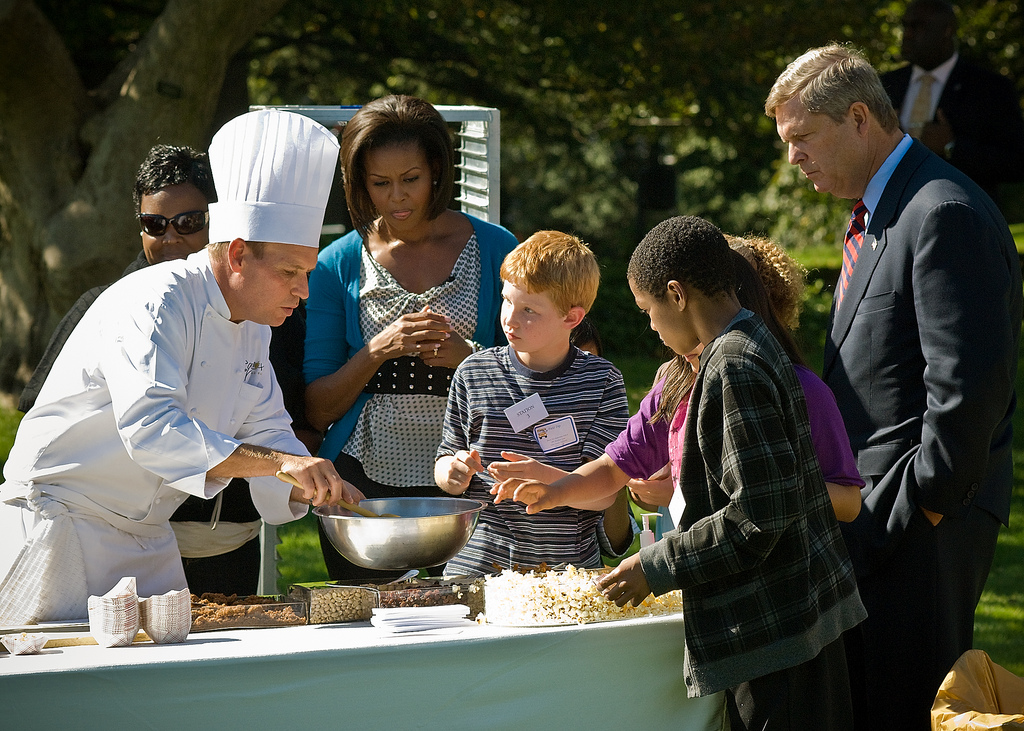
* Chef Todd Gray, “Equinox”, prepares “Sweet and Zesty Popcorn” at a Healthy Cooking Demonstartion for First Lady Michelle Obama and Agriculture Secretary Tom Vilsack at the Healthier US School Challenge Wednesday, October 21. Congress is currently considering the Childhood Nutrition Reauthorization legislation, which impacts the National School Lunch and Breakfast programs. Secretary Vilsack cited the importance of proposals to eliminate barriers that keep children from participating in school nutrition programs, improve the quality of school meals and the health of the school environment, and enhance program performance. (Courtesy USDA Flickr Stream.)
The following is the press release that the Make Our Food Safe campaign released after their visit to the White House. (For more analysis, page visit Obama Foodorama.)
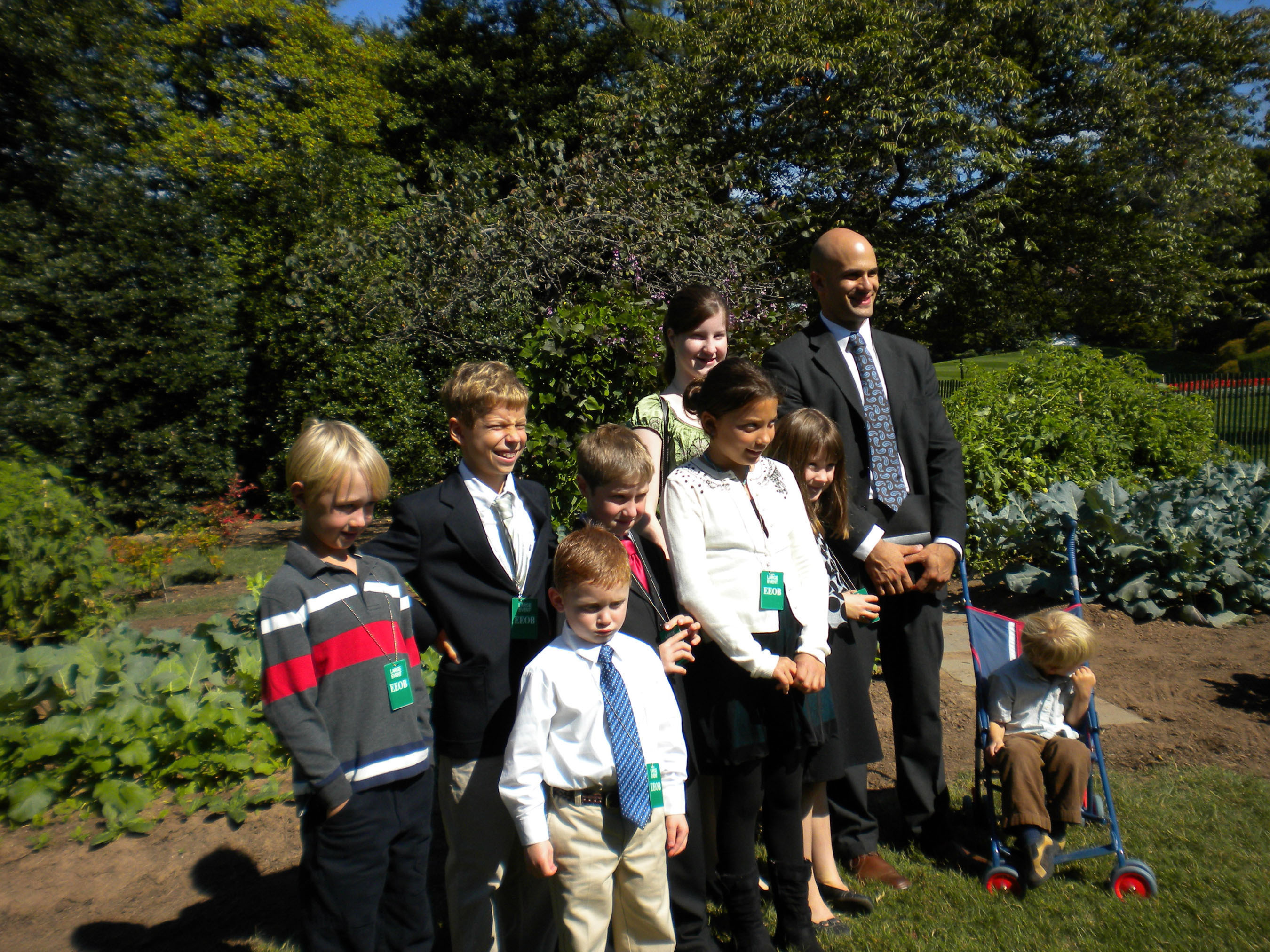
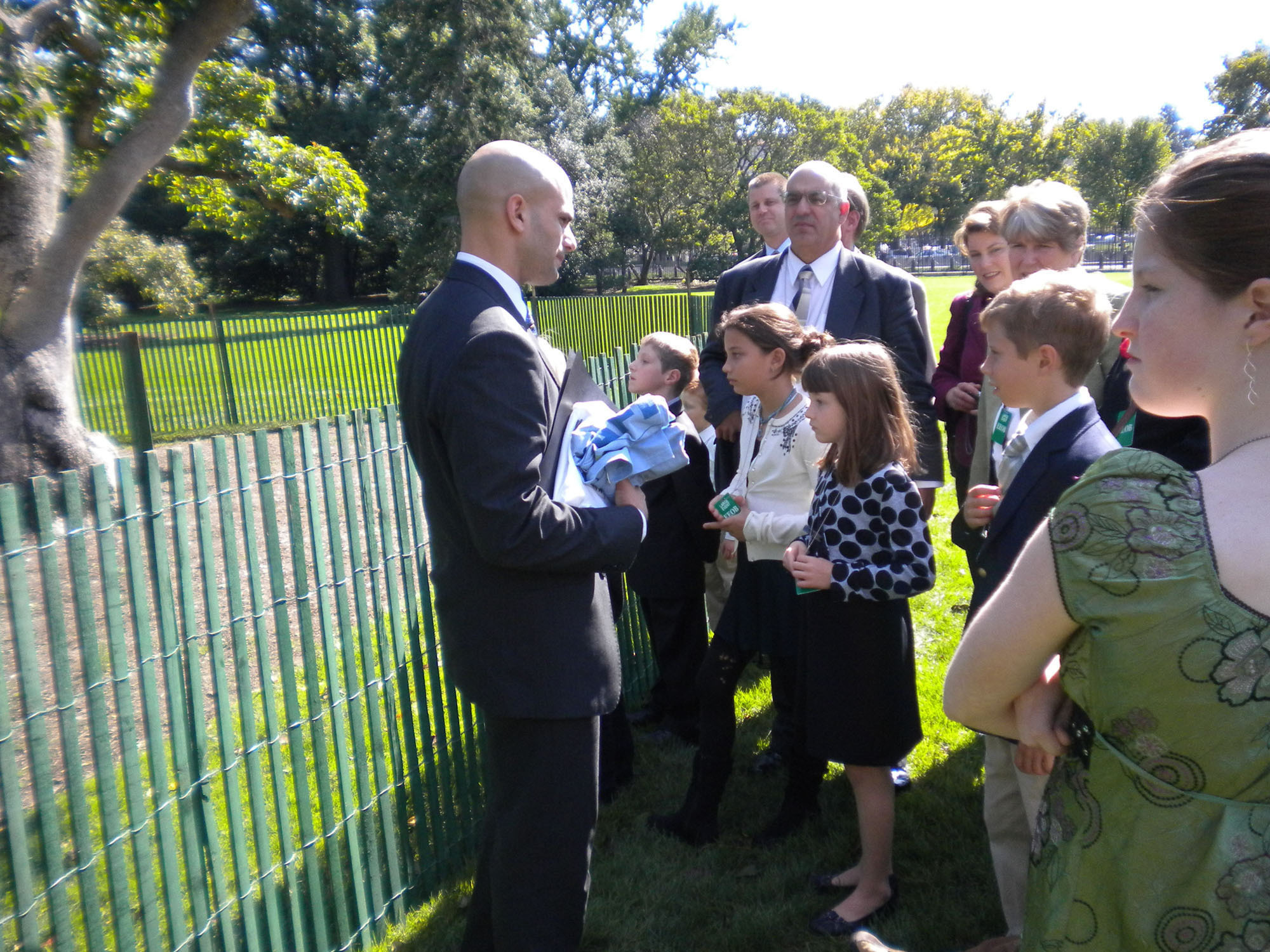
WASHINGTON, audiologist Oct. 19 – Sixteen Americans who have been directly affected by foodborne illness gathered at the White House recently to share their personal stories and meet Sam Kass, assistant White House chef, who cooks for the Obama family and is an advisor on food policy; Mariano-Florentino Cuellar, who is the lead staffer for the White House Food Safety Working Group; and David Lazarus, senior advisor to the Secretary of Agriculture, who coordinates with the White House on food safety issues.
Representing the millions of Americans who fall ill each year from contaminated food, the victims and relatives of victims appealed to the Obama administration to urge congressional lawmakers to pass food safety legislation this year.
“Too many Americans are needlessly getting sick and many are dying from eating food that should be safe,” said Peter Hurley, who traveled from Oregon to D.C. with his 5-year-old son, Jake. Jake became ill earlier this year after eating peanut butter crackers contaminated with Salmonella.
“Congress needs to pass this legislation,” continued Hurley. “It makes the common sense changes our food safety system needs. We know the system can and must be improved and the time for action is now.”
In March of this year President Obama created the White House Food Safety Working Group, which is charged with coordinating federal food safety efforts. At the meeting on Oct. 9 administration officials reaffirmed their commitment to modernizing our food safety system and ensuring that America’s food supply is both safe and healthy.
Advocates from the Center for Foodborne Illness Research & Prevention, The Pew Charitable Trusts, Safe Tables Our Priority (S.T.O.P.), the Center for Science in the Public Interest, Consumers Union, the Consumer Federation of America, and Food & Water Watch joined the 16 Americans who have personal stories about the impact of foodborne illnesses.
While in Washington the victims and relatives of victims also met with U.S. Food and Drug Administration Commissioner Margaret Hamburg, along with senators and Senate staff from their home states. Senators were urged to follow the example set by their colleagues in the House — who passed a bipartisan food safety bill in July — and approve companion legislation by Thanksgiving.
“We cannot afford to wait for another outbreak. Congress must act now and pass food safety legislation that protects families from facing the same hardships we have,” said Maine resident Carol Kintner Gates, who lost a family member to a foodborne illness. “Nobody in America should have to worry about whether the food they eat and feed their family will cause severe illness or death.”
Thousands of Americans die annually from foodborne illness, and about half of all reported cases of foodborne illness occur in children, according to the Centers for Disease Control and Prevention.
Megan Kowalcyk, a 13-year-old from Ohio, lost her brother to foodborne illness and talked with Obama administration officials at the meeting about her efforts to improve food safety.
“I was 5 years old when my brother died,” Kowalcyk said. “He was my best friend and I still miss him. It really bothers me that so many kids have been hurt or died because of foodborne illness.”
Without immediate reform, the preventable outbreaks from contaminated food — like those that occurred earlier this year — are likely to continue.
The following victims and family members were present at the White House meeting, as well as representatives from the Make Our Food Safe campaign (www.makeourfoodsafe.org):
Barbara Kowalcyk, Ohio
Lara Kowalcyk, Ohio
Megan Kowalcyk, Ohio
Patricia Buck, Pennsylvania
Aidan Buck, Pennsylvania
Carol Kintner Gates, Maine/New Hampshire
Jake Hurley, Oregon
Peter Hurley, Oregon
Trissi Fair Bennett, Virginia
Paul Bennett, Virginia
Chloe Bennett, Virginia
Luke Bennett, Virginia
John Christoferson, Oregon
Thomas Christoferson, Oregon
Chrissy Christoferson, Oregon
Karl Christoferson, Oregon
ABOUT MAKE OUR FOOD SAFE:
Major public health, consumer and food safety groups have launched the Make Our Food Safe Campaign (www.makeourfoodsafe.org), including the American Public Health Association, Center for Foodborne Illness Research & Prevention, Center for Science in the Public Interest, the Consumer Federation of America, Consumers Union, Food & Water Watch, National Consumers League, The Pew Charitable Trusts, Safe Tables Our Priority, and Trust for America’s Health.
SOURCE Make Our Food Safe Campaign
Top Image: Front to back – Jake Hurley, Thomas Christoferson, Luke Bennett, Aidan Buck, Chloe Bennett, Lara Kowalcyk, Megan Kowalcyk, Sam Kass, John Christoferson.
Bottom Image: Sam Kass, and Right to left – Megan Kowalcyk, Luke Bennett, Lara Kowalcyk, Chloe Bennett, Aidan Buck, Patricia Buck, Barbara Kowalcyk, Tony Corbo, Peter Hurley.
Posted in Uncategorized | Comments Off on Foodborne Illness Victims Meet With White House to Push for Food Safety Reform